The Old Man of the Sachsenwald
1890 - 1898
William I died on March 9th, 1888, William I, and was followed into the grave by the terminally ill Frederick III (the former Crown Prince Frederick William) on June XNUMXth. His son ascended the throne the next day as William II . This change of rulers shook the hitherto unchallenged position of power of the "Iron Chancellor". Although the new emperor admired Bismarck's political achievements, he increasingly saw him as an obstacle to the development of his own political initiatives. Due to conflicting views on the working class question, Bismarck resigned from his post as Prussian trade minister as early as January 1890. His attempts to find allies in his power struggle with the monarch failed. Disagreements over Russian policy and the Anti-Socialist Law, but also the loss of the majority of the "cartel parties" supporting the government (Conservatives and National Liberals) in the parliamentary elections of February 20th, 1890, provided the Emperor with a welcome opportunity to ultimately demand the Imperial Chancellor's resignation on March 17th. One day later, the latter submitted his resignation letter. The document was so skilfully formulated by him that the causes of the rupture could be blamed solely on William II. The Emperor then forbade the publication of the text. The government version was that Bismarck's resignation had been voluntary for health reasons. On March 20th, the monarch approved the resignation, naming Bismarck Duke of Lauenburg in his reply - a title the honoured man is said never to have used. On the same day, William II appointed General Leo von Caprivi as the new Imperial Chancellor.
 Document dismissing Prince Bismarck from his offices, 20 March 1890 (1st page)
Retreat into the private sphere? Bismarck in "restless retirement"
On March 29th, 1890, the former Chancellor left the capital and spent the last years of his life - interrupted only by a few trips - at his residence in Friedrichsruh near Hamburg. Financially, the large landowner was well secured: his annual income in March 1890 was around 330.000 marks. The sum was made up of the income from his estates as well as his pension and interest income. In addition, he had a portfolio of stocks amounting to just over 1,2 million marks.
On his departure from Berlin, Bismarck was accompanied by his elder son Herbert. The latter had entered the diplomatic service in 1873 and was appointed State Secretary of the Foreign Office in 1886. Contrary to the Emperor's wishes, he now resigned from his post in solidarity with his father. While foreign countries were alarmed by Bismarck's fall, grief over it was limited in Germany. Both Bismarck's moderate foreign policy and his repressive domestic policy were considered by many Germans to be outmoded and not forward-looking - his time as the director of Prussian-German politics had expired.
He indulged in hunting on his estates and used the time for horseback rides and drives as well as walks in the surrounding countryside. But the political business did not let him go. In Friedrichsruh he received German and foreign heads of state and politicians. In 1895, the Grand Duke and Grand Duchess of Mecklenburg-Schwerin visited him, in 1896 the Chinese statesman and General Li Hongzhang, king the following year Chulalong Korn (Rama V.) of Siam (Thailand) and Grand Duke Carl Alexander of Saxony-Weimar-Eisenach. In addition to high-ranking personalities, historians, publicists and journalists also came to Bismarck's mansion. Through the latter, as well as the "Hamburger Nachrichten", whose owner had offered to make the paper available to the former Chancellor as a mouthpiece for his views, he commented in countless articles on current affairs and the policies of his successor, which he derided, among other things, as "caprivioles". At the end of April 1891, to the horror of the court and the Reich leadership, he ran for a seat in the Reichstag in a Hanoverian constituency as the candidate of the National Liberals. In the run-off election he won over his Social Democratic opponent. Although he accepted the mandate, he did not exercise it - the political leaders in Berlin could breathe a sigh of relief.
 Otto von Bismarck and his son Herbert (© Otto-von-Bismarck-Stiftung)
From cult to myth
When his successors in the office of Imperial Chancellor and Kaiser William II were unable to fulfil the public's high expectations for the "New Course", the population began to think back to the "founder of the Reich". National liberals and conservatives, but also the "national associations", student fraternities and sections of the Protestant urban bourgeoisie contributed with their veneration of Bismarck to an increasingly positive assessment of his person and political work. "Fatherland" minded Germans elevated Bismarck to a symbol of the Reich and the German nation in their search for a national identification figure. Cautionary voices reminding people of the darker sides of the Bismarck era remained in the minority.
Bismarck's trip to Vienna on the occasion of the marriage of his son Herbert to the Hungarian countess Marguerite von Hoyos in the summer of 1892 became a triumphal procession. Wherever he stopped on the way there and back, cheering crowds awaited him; this was not least a reaction to the efforts of William II and Imperial Chancellor Caprivi, which had become public knowledge, to press in Vienna for Bismarck not to be given an official reception. The latter's popularity rose again, while the Emperor's reputation threatened to be seriously damaged in view of the rift. The court therefore decided to offer the Bismarcks a hand of reconciliation, especially as the former Chancellor of the German Empire fell critically ill in August 1893 (only a few months earlier, in May, his brother Bernhard had died). At the beginning of January 1894, Bismarck, who had recovered, visited William II in Berlin, and the Emperor returned the visit to Friedrichsruh in February. Outwardly, the good relationship between the two had been restored, but in reality the rift between them could no longer be healed.
 "America at Bismarck's" is the title of this photo, which was published in 1892 in the album "Bismarckbilder aus dem Sachsenwalde" (Bismarck Pictures from Saxony Forest) by the Literary Society Leipzig.
On his birthdays and national holidays, thousands of admirers paid homage to the "Old Man in the Saxon Forest" in Friedrichsruh. More than 450 towns named him their honorary citizen. Numerous monuments were erected in his honour, and streets, squares and towns were named after him all over the world. Even foodstuffs and everyday objects bore the name of the "founder of the empire". In addition, literary and artistic veneration was expressed in biographies, poems, sermons, musical compositions, paintings and drawings, small sculptures, medals, postcards and photographs.
On his 80th birthday on April 1st, 1895, in addition to official tributes, several hundred thousand congratulatory letters and around ten thousand telegrams reached Friedrichsruh, which was visited by numerous delegations. The majority of the Reichstag, however, refused to honour the jubilarian with a congratulatory address.
The former Chancellor of the Reich fuelled the cult, which grew into a veritable myth, with press articles, publications and the memoirs ("Gedanken und Erinnerungen") he started after his dismissal. His long-time collaborator Lothar Bucher took on the task of structuring the orally recited memoirs, frequently encountering contradictions between Bismarck's narratives and the historical facts, much to his chagrin. The first two volumes of the work were published by Cotta in 1898 soon after the death of the former Chancellor of the German Empire and became bestsellers. The third volume was not published until 1921 - three years after the end of the monarchy - in consideration of the emperor's person.
In this way, the former Imperial Chancellor actively contributed to the fact that Bismarck the man and his historical legacy largely began to disappear behind a transfiguring portrayal. The veneration of Bismarck became an integral part of the culture of remembrance in the Empire. It served to legitimise the political-social order and was an expression of the Germans' search for identity. However, due to his struggle against political and ethnic minorities, Bismarck never became a national identification figure for the entire population. Only after the death of the "founder of the Reich" did Catholic sections of the population and critics from the Protestant-bourgeois camp begin to evaluate Bismarck and his politics more positively.
 Lothar Bucher in Friedrichsruh, drawing by Christian William Allers, 1892
The death of his wife Johanna on November 24th, 1894, severely shook the "old man in the Sachsenwald"; everything now seemed "barren and empty to him." From then on - cared for by his family and his personal physician Schweninger - he never left Friedrichsruh. He increasingly lost his courage to face life, to which his deteriorating physical condition also contributed. Nevertheless, he celebrated his 1897th anniversary of military service in March 60. In mid-December, sitting in a wheelchair, he received Kaiser William II for the last time for a short visit in Friedrichsruh. The last months of his life became a real torment because of severe pain. Bismarck died on July 30th, 1898, shortly before 23 p.m. in the bedroom of his mansion in Friedrichsruh. In his last words he is said to have expressed the hope of seeing his Johanna again in heaven.
The von Bismarck family refused Wilhelm II's wish to bury the deceased in the Hohenzollern crypt of Berlin Cathedral. Rather, a mausoleum was built opposite the manor house in which Otto and Johanna von Bismarck found their final resting place together on March 16, 1899 – the eleventh anniversary of the funeral of Kaiser Wilhelm I.
 The postcard shows the mausoleum of the von Bismarck family in Friedrichsruh (© Otto-von-Bismarck-Stiftung)
Video: "Friedrichsruh and the old man from the Sachsenwald"
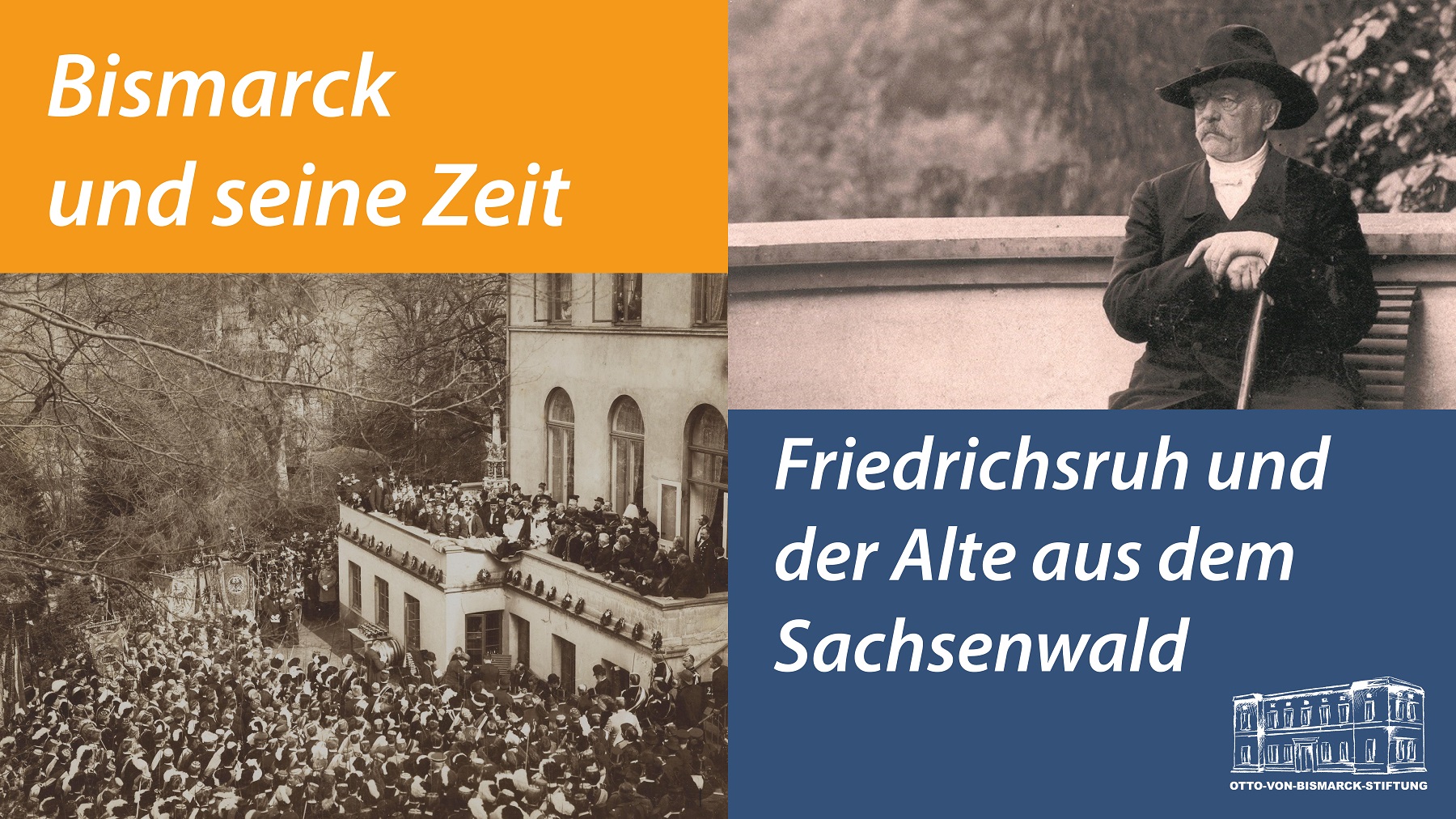
To this day, Friedrichsruh is inextricably linked to Otto von Bismarck. In 1871 he received parts of the Sachsenwald from Kaiser Wilhelm I as thanks for his services to the founding of the empire and settled in the tranquil town on the Hamburg – Berlin railway line. However, the calm was soon over there, like this one Video shows.