Diplomat
1851 - 1862
Diplomatic apprenticeship: Envoy to the German Confederation
In the years between 1851 and 1862 Otto von Bismarck the opportunity to prove themselves in the field of foreign policy. Frederick William IV. appointed the only 36-year-old on the advice of his adjutant general Leopold von Gerlach in May 1851 to the legation council of the Prussian legation at the German Confederation.
The court now considered the nobleman from Altmark Brandenburg suitable to represent Prussian interests in the Federal Assembly. This was a permanent congress of envoys from the member states of the German Confederation, which met in Frankfurt am Main. In order to familiarise himself with the diplomatic customs, Bismarck - who was also promoted to Privy Councillor by the King - was initially only second in command at the legation. In July 1851 he was finally appointed Prussian envoy.
 King Frederick William IV of Prussia, painting by Joseph Karl Stieler (attributed), around 1845 (© Otto-von-Bismarck-Stiftung)
Bismarck remained a member of the Lower House of Parliament. However, he vacated the seat he had won in October 1851 the following year after a pistol duel with the Liberal MP Georg von Vincke, in which both opponents remained unharmed. This was not a final farewell from Berlin, however, for the political hopeful of the conservatives was appointed to the First Chamber (since 1854: Herrenhaus [House of Lords]) in November 1855 at the suggestion of the landowners of Pomerania.
Bismarck quickly familiarised himself with his new area of responsibility and provided the government in Berlin with information about conditions in Frankfurt; in doing so, he was pleased with his increasing ability to "say nothing at all with many words". In October 1851, his family followed him and he enjoyed the cosmopolitan atmosphere in the city as much as the family and social life.
His diplomatic activities focused on the problem of Austro-Prussian dualism in Germany. Although initially not fundamentally hostile to the Habsburg monarchy, as Prussia's representative he fought to strengthen his country against Austria, the leading German power.
Bismarck opposed Austria's efforts to instrumentalise the German Confederation for its own purposes. He succeeded in preventing the Viennese government from expanding the German Confederation in terms of trade and economic policy at the expense of the German Customs Union, founded in 1834. He also blocked their attempt to mobilise troops of the German Confederation against Russia during the Crimean War (1853 - 1856) - this was his first significant diplomatic success! However, he did not succeed in shaking Austria's supremacy. He repeatedly advised his superiors in Berlin to pursue a more active foreign policy, because sooner or later – he was convinced – Prussia would become an "anvil" if it did nothing "to become a hammer".
 Johanna von Bismarck supported her husband in the social arena in Frankfurt in her role as the wife of a diplomat. Painting by Jakob Becker, 1859 (reproduction, © Otto-von-Bismarck-Stiftung / Photographer: Jürgen Hollweg)
He followed with curiosity the rise of Napoleon III in France, which had once again become the continent's leading power with its victory in the Crimean War. In 1855, Bismarck took advantage of a trip to the Paris World's Fair to meet the Emperor of the French in person. This was followed in 1857 by Bismarck's second stay in Paris, during which further meetings took place. His highly conservative patrons at court eyed Bismarck's interest in the Second French Empire with suspicion, considering it a hotbed of revolution with which no cooperation was possible. Prussia's man in Frankfurt, on the other hand, was convinced that Napoleon III should also be considered as a possible ally, despite ideological differences. According to Bismarck, the government in Berlin had to "work with realities and not with fictions". It should therefore pursue "realpolitik" (Ludwig von Rochau) and be less oriented towards anti-revolutionary principles which might run counter to Prussian state interests.
 Napoleon III. (1808 – 1873), Emperor of the French. Hand-colored steel engraving by Daniel John Pound, after a painting by Franz Xaver Winterhalter, around 1860 (private collection)
"Put on ice": Envoy to the Tsar's Court
After Frederic William IV handed over the reins of government to his brother Wilhelm in 1858 due to illness, Bismarck was politically sidelined because of the aforementioned statements. The regent appointed a new, liberal-conservative government, which transferred the diplomat, who had a reputation as a supporter of an authoritarian form of government, to St. Petersburg at the end of January 1859. Formally, this was a promotion, but Bismarck perceived it as being taken out of the game. The new envoy received a decidedly friendly reception at the court of Emperor Alexander II . He learned Russian, familiarised himself with the political conditions of the Tsarist Empire and established close relations with Russian government representatives.
At the beginning of May 1859, against the background of the 2nd Italian War of Independence, Bismarck drafted a programme for the establishment of Prussian hegemony in Germany. In doing so, he even adopted demands of the German national movement. Immediately afterwards, Bismarck - shortly before setting off on a journey to Prussia to fetch his family - fell critically ill. Nevertheless, he departed and left the Russian capital for almost a year. Recovered, he was received by the Prince Regent in Berlin on his way back to St. Petersburg in March 1860.
 Otto von Bismarck, photograph by Elise Wolff, 1859 (© Otto-von-Bismarck-Stiftung)
As a result of the domestic political conflict that had been intensifying since 1859/60 over the reform of the armed forces desired by the head of state, Bismarck was traded in Berlin as a candidate for minister in the event of a government reshuffle. But Prince Regent Wilhelm had reservations about him; Wilhelm's wife Augusta also came out firmly against the supposed reactionary from the Altmark. The relationship between Augusta and Bismarck had been based on mutual dislike since the revolution of 1848/49. In June 1860, Bismarck finally returned to his post in St. Petersburg, his family in tow. He reported to his superiors from the Russian capital and kept an eye on political developments in Europe and Germany from afar.
In the summer of 1861, during a visit to Germany, Bismarck was ordered to Baden-Baden to meet the new king – after the death of Frederick William IV in January 1861, the Prince Regent had ascended the Prussian throne as William I . Bismarck developed a programme for Prussian policy on Germany: Prussia should use the national unification movement as "leverage" to "gain the upper hand in the struggle against Austria and the Central States". Rumours again circulated that Bismarck would be appointed to the Prussian Ministry of State, but no such offer was made. After attending the coronation of William I in Königsberg on October 18th, 1861, he returned to St Petersburg. His hour had not yet come, but in March 1862 his time in Russia was up and he returned to Berlin.
Meanwhile, the conflict between the Crown and Parliament over the question of army reform intensified. It was suggested from the monarch's entourage that Bismarck be appointed to the government, but William I was still reluctant to entrust the "flighty" diplomat with a ministerial post.
 She remained a political opponent of Bismarck: Augusta, Queen of Prussia and later German Empress. Portrait based on a model by Richard Lauchert, around 1870 (© Otto-von-Bismarck-Stiftung)
On call duty: envoy in Paris
After Bismarck had emphatically asked to be "appointed or dismissed", he was transferred to the Prussian legation in Paris in May 1862. Bismarck spoke fluent French and had already become acquainted with the country on earlier trips. The new Prussian envoy was also received with goodwill at the court of Emperor Napoleon III, who endeavoured to maintain good relations with Prussia. As social life in the French capital was largely at a standstill in the summer of 1862, Bismarck took the opportunity to visit the Great Exhibition in London. There he also held talks with the Prime Minister Henry John Temple, Viscount Palmerston, and the leader of the opposition, Benjamin Disraeli.
No sooner had he returned to Paris than he took leave and travelled to the south of France. In the seaside resort of Biarritz he met the Russian envoy to Belgium, Prince Nikolai Orlov, and his young wife Catherine Orlova. Bismarck spent a lot of time with them and fell in love with the "cute Principesse" (Princess), who reminded him of his first great love Marie von Thadden . He extended his holiday on his own authority and enjoyed being with his beloved. In the end, the romance was inconsequential, and after a short stay in the Pyrenees, Bismarck returned to Paris. There, in mid-September 1862, he received telegrams from the Prussian Foreign Minister Albrecht von Bernstorff and the Prussian Minister of War Albrecht von Roon, urging him to report to Berlin immediately.
 Prince Nikolai Orlov and his wife Princess Katharina Orlova, around 1860 (© Otto-von-Bismarck-Stiftung)
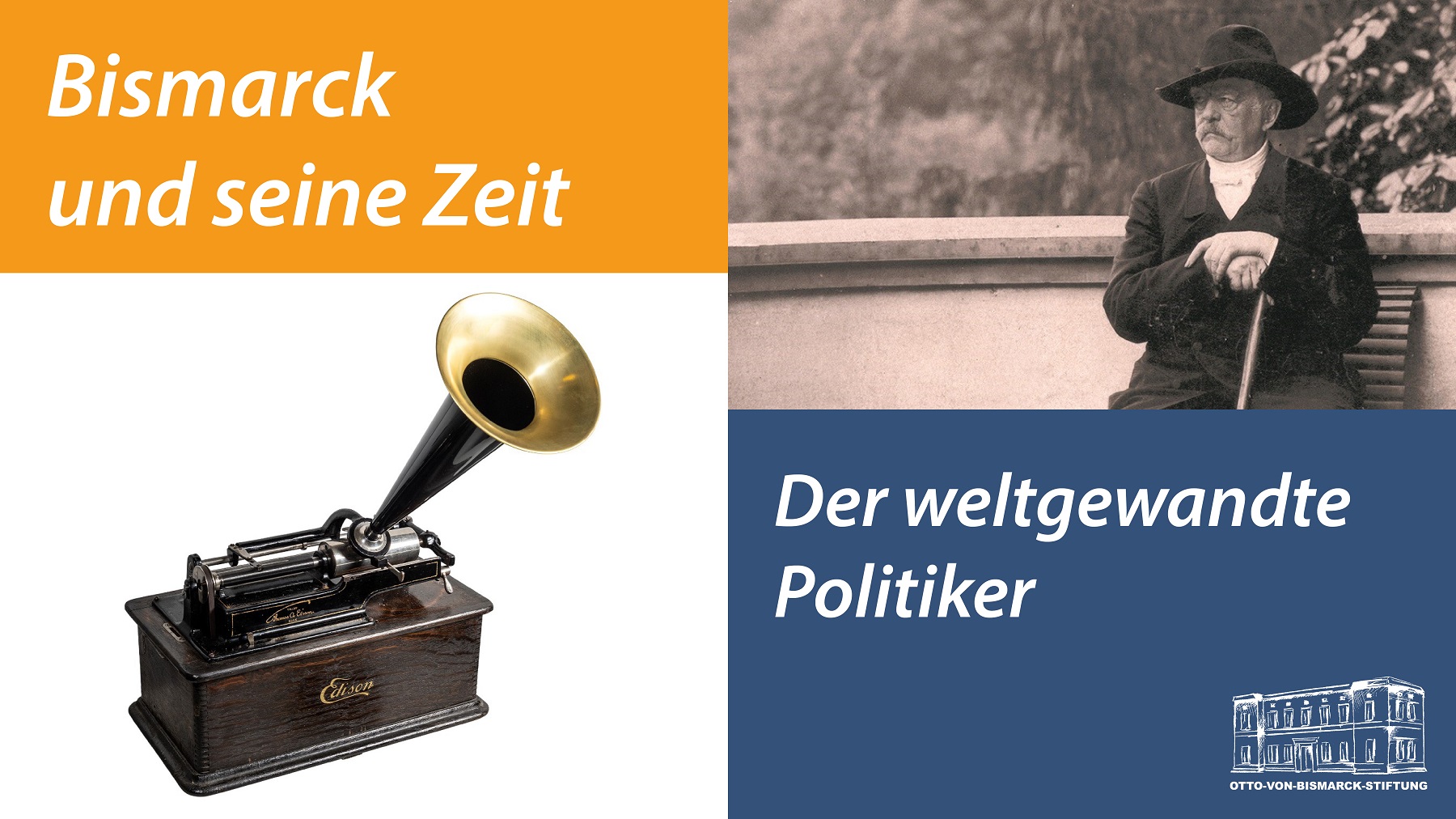
Video: The urbane politician
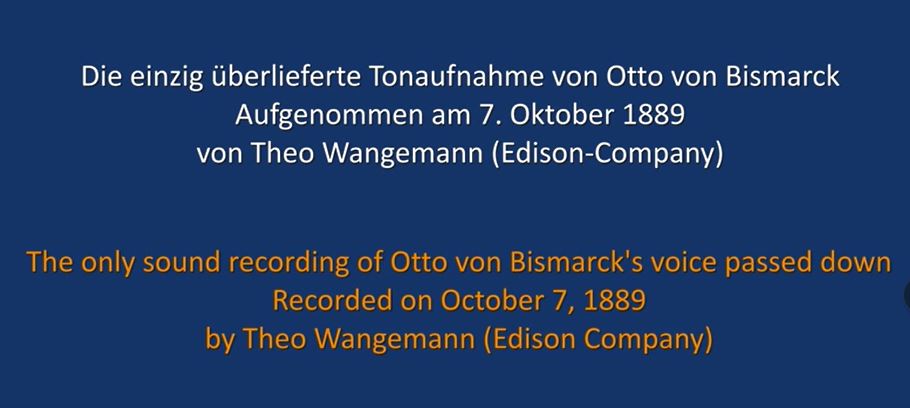
Otto von Bismarck traveled to many European countries for work and pleasure and lived as a diplomat in Paris and St. Petersburg, as in the video "The Worldly Politician" you can see. An impression of his foreign language skills is still given today Sound recording, thanks to an invention by Thomas Edison.