A myth emerges
1890 - 1914
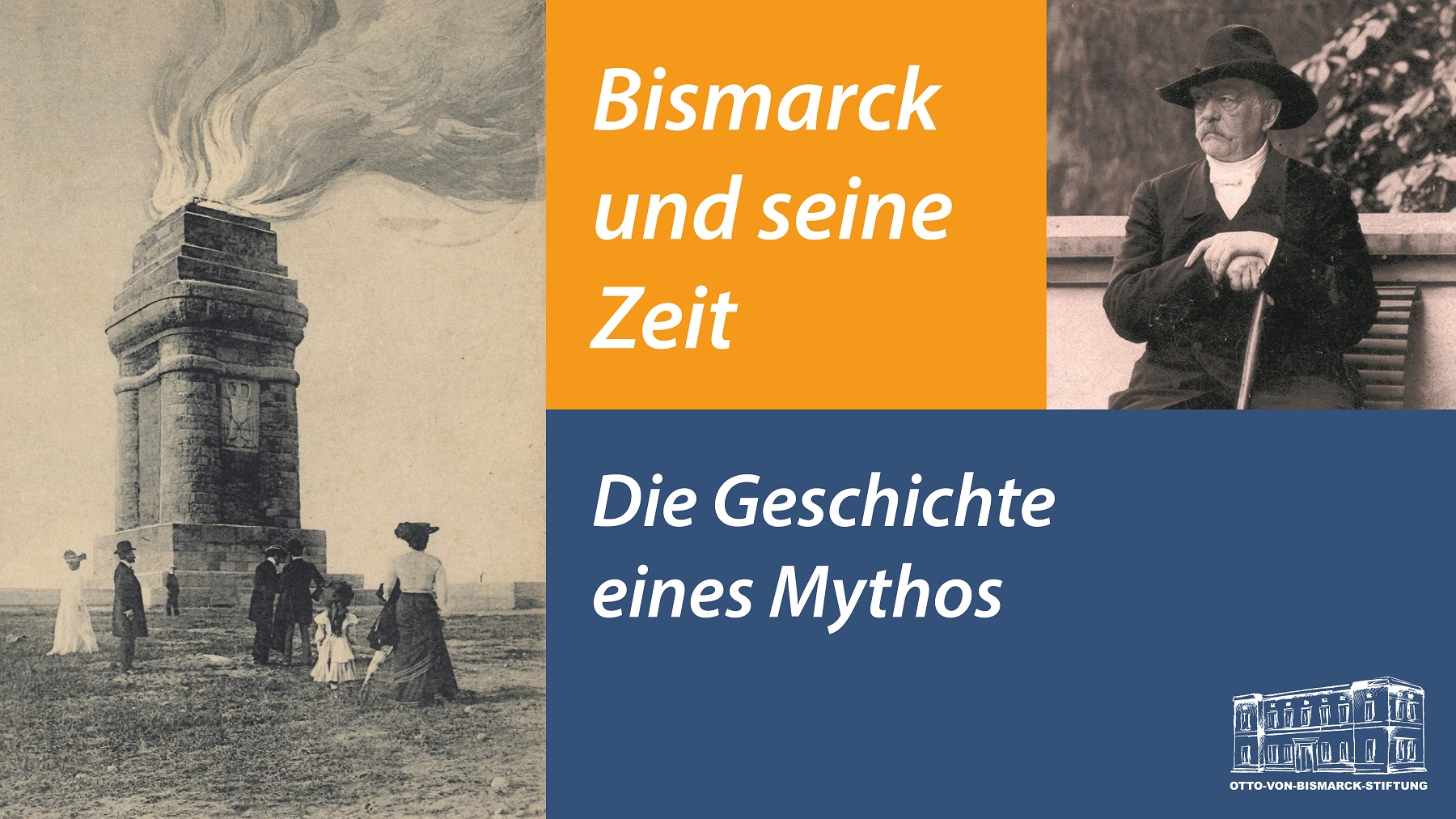
From a historical-critical perspective, the name Otto von Bismarck encompasses two entities: the actual the politician with his achievements and failures, and the mythically transfigured founder of the German Empire, who was already venerated in his lifetime. In the years leading up to the First World War, he became a part of Germany's topographical memory landscape through a large number of monuments and streets named after him. Both - the actual person and the mythical figure - can be discussed against the background of their time and on a scientific basis. In this way, the respective images that Bismarck's contemporaries and their descendants made of him can be deciphered.
Bismarck becomes a cult figure
Part of the prologue of the Bismarck myth is the cult that began around the Imperial Chancellor during his years in office. This phenomenon was not a German invention: In the age of the founding of nation-states, politically leading circles in various countries developed similar narratives. With the intention of highlighting the respective state unification and greatness, a person was placed at the centre. Thus, monuments to GeorgeWashington and Abraham Lincolnwere erected in the USA, Giuseppe Garibaldi became ubiquitous in Italy and Napoleon I. in France. In Germany, Bismarck served as a projection surface for the narrative.
The patriotic attributions ascribed to him were subject to conjunctures and stylistic changes in journalism, street furniture and festive culture. The "Faithful of Jever", who regularly sent the Imperial Chancellor 1871 lapwing eggs on his birthday from 101 onwards and always accompanied this gift with publicity, thus were far ahead of their time. Even earlier, in 1869, the first of 240 Bismarck towers was inaugurated in the Owl Mountains. In 1871, the Prussian-savvy bourgeois elites of Dresden felt obliged to dedicate one of the first municipal Bismarck squares in the city centre. Bismarck himself soon became accustomed to the publicly visible dedications of his person, although he had still been somewhat bemused by the first statue depicting him, which was erected in Kissingen in 1877.
At the festivities, in pamphlets and tributes on Bismarck's 70th birthday in 1885, there were already hints of the potential his person held, especially for national Protestant circles. During his reign, however, the exaggerations of later years did not yet occur, when he was hyped as an almost messianic executor figure of German history.
 The farewell address of the Berlin citizenship was written on the occasion of Otto von Bismarck's dismissal from his offices and is evidence of the cult that spread around the "founder of the empire". Drawing by W. Friedrich, 1890 (© Otto-von-Bismarck-Stiftung)
Collaborating on his own legend
When Emperor William II in 1890, broad sections of the population longed approvingly for a new political beginning. The less these hopes were subsequently fulfilled, the more people looked back on the decades under the first Imperial Chancellor with misty-eyed nostalgia. The memory of his controversial policies slowly began to fade, and he himself played a part in this: in the last years of his life, he worked diligently on his own legend. In fluent transition, the cult around him became the Bismarck myth, which integrated partly contradictory political statements and made the founder of the German Reich connectable in various directions.
The high point was marked by his 80th birthday in 1895, when tens of thousands of individual and group visitors from a wide variety of backgrounds made a pilgrimage to the "old man in the Sachsenwald" to cheer him and give him presents. The Bismarck Museum, opened in his birthplace Schönhausen in 1891, owed numerous exhibits to this special anniversary.
In the German Empire, the German-speaking territories of the Habsburg Monarchy and the European and overseas settlement areas of German emigrants, the congratulatory addresses were followed by a flood of monuments being erected and streets being named. Plant species, liquors and the famous herring were given his name. Universities awarded him honorary doctorates, city after city made him an honorary citizen, clubs and associations made him an honorary member.
 Bismarck was cheered on his 80th birthday on April 1, 1895 by thousands of admirers who had gathered in the park of the Friedrichsruh manor house. The celebrant, who is standing on the terrace with his birthday party, can be recognized by his spiked helmet (© Otto-von-Bismarck-Stiftung).
The middle classes are looking for a hero
With a few exceptions - such as the Bismarck National Monument in front of the Reichstag, which was inaugurated in 1901 – these honours were not initiated by the state. They sprang from local initiatives, in which not infrequently a municipality tried to patriotically outdo the neighbouring municipality. More than 500 monuments bear witness to this desire for nationally reliable self-positioning. It was not until around 1905 that the erection of Bismarck monuments and towers slowly ebbed away. The idea of a gigantic Bismarck monument on the Elisenhöhe near Bingen on the Rhine was not realised after the First World War, nor was the multitude of smaller tributes planned for the 100th anniversary of his birth in 1915. At the end of the peacetime phase of the Empire, the expansion of the public honour regime for its founder also came to an end for the time being.
 The plate was sold on the occasion of the 100th birthday of the first Reich Chancellor. The quote, which comes from a keynote address on foreign policy on February 6, 1888 in the Reichstag, reads in full: "We Germans fear God, nothing else in the world and it is the fear of God that makes us love and cultivate peace." ( © Otto-von-Bismarck-Stiftung)
Not a role model for everyone
A closer look reveals striking geographical differences. For the uncritical heroic narrative about the hands-on monarchist from Protestant Prussia did not meet with approval everywhere in Germany, neither before his dismissal nor after his death or beyond. The refusal of the Reichstag to formally issue to the old man a birthday greeting in 1895, which was achieved with the votes of the Catholic Centre, the Social Democrats, the Left Liberals and the Polish deputies, may be regarded as a key event.
If you look at the map of the German Empire, you will find tributes everywhere between the Baltic and Lake Constance. In Catholic Old Bavaria and in the Rhineland, as well as in the Kingdom of Hanover annexed in 1866 and in Electoral Hesse, there are conspicuous gaps in Bismarck statues, busts, fountains, towers, squares, streets, oak trees, pharmacies and schools. The myth surrounding his person thus became part of popular culture in the era of his contemporaries especially in the Protestant parts of Germany.
 The building permit for this Bismarck Tower near Assenhausen on Lake Starnberg was granted on August 25, 1896, which was unusually during Bismarck's lifetime. In Bavaria of all places, it became the second most expensive Bismarck tower ever. Postcard (© Otto-von-Bismarck-Stiftung)
Video: The Story of a Myth
Even during his lifetime, the real politician Otto von Bismarck, with his achievements and failures, began to disappear in public perception behind the heroic figure of the founder of the empire. That Video tells of the beginnings of the Bismarck cult.