Diplomatic years
1851 – 1862
Plenipotentiary at the German Bundestag in Frankfurt am Main
The independent German principalities and the four free cities had founded the German Confederation in 1815. Since then, they sent their plenipotentiaries to Frankfurt am Main, where its only common institution, the German Bundestag, operated. In May 1851, Frederick William IV. appointed Bismarck as Prussian plenipotentiary. Actually, the king did not really approve of sending "this Landwehr lieutenant", as he disparagingly called the diplomat. However, he bowed to the advice of his adjutant general, Leopold von Gerlach.
Bismarck first served as deputy to the acting envoy Theodor von Rochow, then as his successor. Even though he found his new office "thorny", he threw himself into the work with zeal and presented himself as a pioneer of what the public soon called "realpolitik". "We must economise with realities and not with fictions," was his credo. "We will become an anvil if we do nothing to become a hammer".
 Otto von Bismarck as a member of the Bundestag. Painting by Jakob Becker, 1855 (reproduction, © Otto-von-Bismarck-Stiftung)
Bismarck's Idea of the Power State
Important European politicians propagated the idea of a power state at this time. Bismarck also followed this view of politics and elevated the expansion of the power of the Prussian Hohenzollern monarchy to a question of "honour". Prussia was to shed its junior role in the German Confederation and no longer subordinate itself to the Austrian Habsburg monarchy. In Bismarck's view, political common ground existed only where revolutionary dangers to the monarchy had to be fought or liberal constitutions in the federal states had to be eliminated.
Bismarck successfully undermined Austria's plans to reform the German Confederation and set up a Central European Customs Union. It was far more difficult for him to upgrade Prussia's position in Europe. He rated the Emperor of the French as the central figure in the "chess game of politics", Napoleon III
The Crimean War and its consequences
The Crimean War of 1854 to 1856 between Russia on the one hand, France, Great Britain and the Ottoman Empire on the other, massively challenged Bismarck's tactics. While he advocated a readiness for war "in every direction", his government formed an alliance with Austria but did not take up arms. Prussia was briefly excluded from the Pentarchy – the dominion of the five great European powers – because of this zigzag course. Nevertheless, in the end it was one of the beneficiaries of the conflict.
After the Russian defeat and the breaking of the Holy Alliance between St. Petersburg, Vienna and Berlin, a power vacuum arose in Europe after the Peace of Paris of 1856. The Prussian government under Minister-president Otto von Manteuffel did not know how to make use of this situation in terms of power politics, nor did the cabinet under Karl Anton, Prince of Hohenzollern-Sigmaringenappointed in 1859. To avoid having to listen to Bismarck's unsolicited advice, the prince transferred the diplomat from Frankfurt to St. Petersburg at the beginning of XNUMX. Bismarck complained to his sister Malwine that the government was trying to “put him on ice” politically.
 The Crimean War ended on March 30, 1856 with the Peace of Paris. The contractual partners were the Ottoman Empire and its allies France, Great Britain and Sardinia on the one hand and Russia on the other. The contemporary photograph shows the delegates at the Peace Congress (© Otto-von-Bismarck-Stiftung)
"Put on ice" in St. Petersburg
Bismarck had hardly arrived in St. Petersburg at the end of March when he experienced an astonishing change of mood. For he quickly realised that the friendship between Prussia and Russia had survived the turbulence of the recent past unscathed thanks to the kinship relations between the monarchs. The only thing that worried him was the possibility of a Russian-French alliance.
However, France's interference in the Second Italian War of Independence in 1859 prevented close cooperation: the Empire fought alongside the Kingdom of Sardinia-Piedmont against Austria, while Russia remained neutral. Bismarck saw this conflict as "the jackpot". He energetically advised his government to move its armies south. His ideas were similar to the programme of the new German National Association, which aspired to a lesser German nation state with Prussia as the leading power. But such appeals fell on deaf ears with the Berlin government.
Shortly after the end of the war, Bismarck went on home leave, which was to last almost a year due to health problems. His second leave in the summer passed 1861 without complications, but after his return to the Neva he became dissatisfied. In mid-March 1862, Prussia's new Foreign Minister Albrecht von Bernstorff invited the diplomat to Berlin to discuss a new assignment. The decision on Bismarck's transfer was delayed, however, as the monarchy was in deep trouble.
 Otto von Bismarck's passport for the trip to St. Petersburg, signed by Prince Regent William, dated October 7, 1859 and valid for one year (© Otto-von-Bismarck-Stiftung)
Envoy in Paris
After the death of King Frederick William IV, his brother William had ascended the throne in early 1861. His reign was ill-starred. For months, the House of Representatives had blocked an army reform planned by the government. Bismarck observed events from St. Petersburg with a mixture of unease and hope. He feared an increase in the power of the opposition but flirted with the idea of resolving the conflict himself as head of government. King William I , however, could not bring himself to do this. Instead of giving Bismarck executive power, he sent him to Paris as Prussia's envoy on 22 May 1862.
Bismarck immediately went to his new place of work, but the work bored him. The only thing that distracted him were several talks with Napoleon III, for the Emperor presented himself as a "zealous advocate of German unification plans". When the court and the government left for their summer holidays in July, Bismarck travelled to London and then to Biarritz. He did not return to the French capital until September 15th. No sooner had he arrived than he received a telegram that was to change his life dramatically. "Periculum in mora. Dépêchez-vous" ("Danger ahead. Hurry"), telegraphed War Albrecht von Roon.
Appointment as minister-president
Since Bismarck's departure from Berlin, the disputes over the army reform had turned into a real constitutional conflict. William I even toyed with the idea of abdicating. On September 22nd, he confronted his Parisian envoy, who had just arrived, with the question of whether he was prepared to push through the army reform against the House of Representatives. Without hesitation, Bismarck declared that he would avert the threat of "parliamentary rule" if necessary "by a period of dictatorship". On the same day, the king appointed the diplomat as minister-president.
 Otto von Bismarck headed the Prussian embassy in Paris from March to September 1862 and was received by the French imperial couple during this time. For the first time, Bismarck and Napoleon III. already met in 1855 at a ball in Versailles.
Drawing by Carl Röhling, from: Otto von Bismarck. Ernstes und Heiteres aus dem Leben des grossen Kanzlers, Berlin 1897 (in the public domain).
 Teacher and student, caricature, from: Kladderadatsch, No. 48 of October 18, 1862. The diplomat Bismarck says goodbye to his "teacher" Napoleon III. The satirists wondered whether the new Prussian Prime Minister could have learned the art of the coup d'état from the French Emperor (public domain).
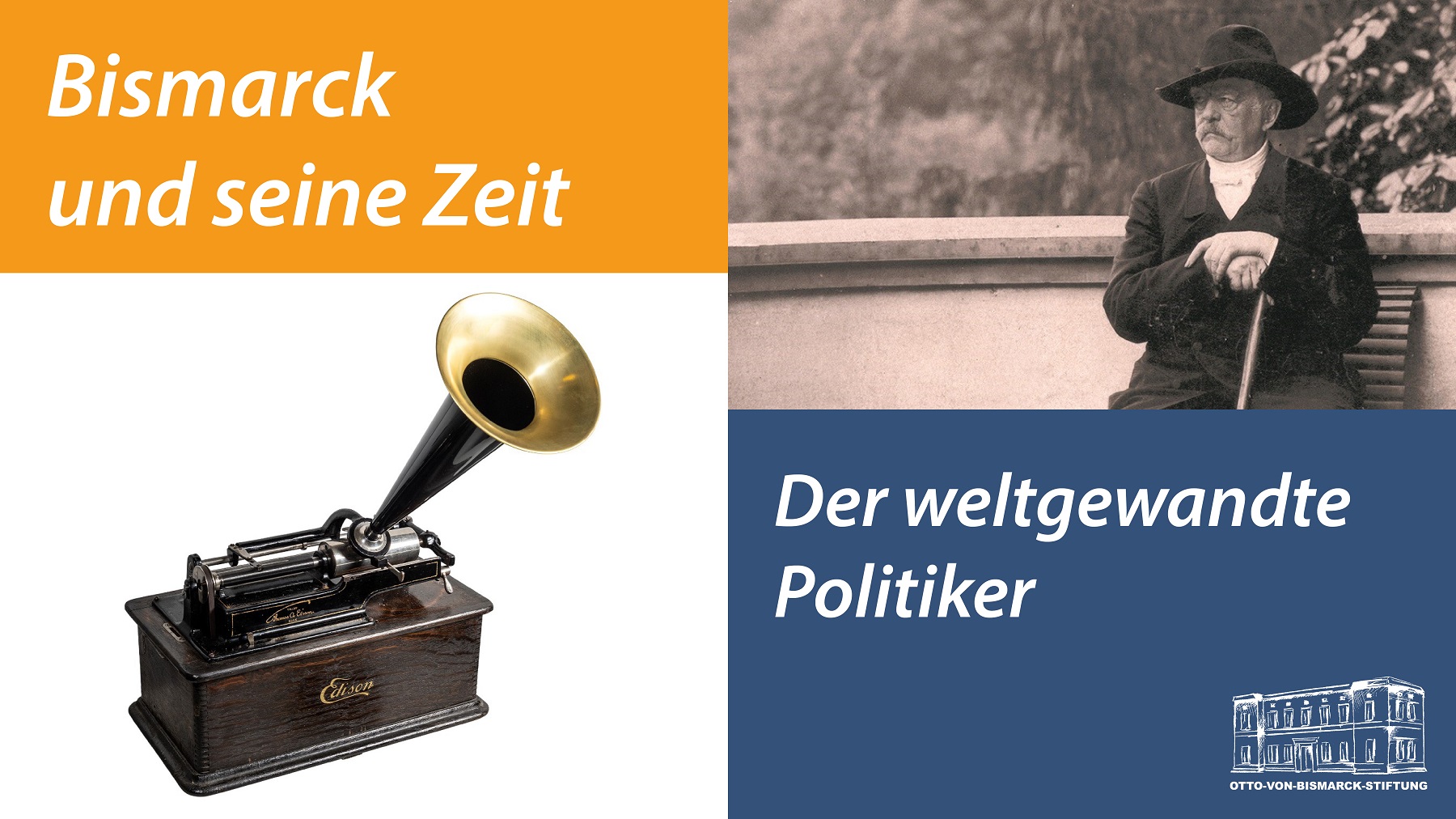
Video: The urbane politician
Otto von Bismarck traveled to many European countries on business and privately and lived as a diplomat in Paris and St. Petersburg, as the video shows "The Worldly Politician" indicates. An impression of his foreign language skills is still given today Sound recording, thanks to an invention by Thomas Edison.