Global and Colonial Policy
1862 – 1890
"Cordial agreement" with the USA
Bismarck's foreign policy was always focused on the five great European powers. But the world of the 19th century was undergoing a profound "transformation" (Jürgen Osterhammel). The internationalisation of trade, the expansion of means of communication and global migration flows led to economic networking and brought the world closer together both socially and culturally.
Bismarck certainly took note of these global processes of change. Even as a student, he had learned the terms world state system and world equilibrium from the historian Arnold Heeren . It was also Heeren who made him aware of the international significance of the USA. As minister-president and Imperial Chancellor, Bismarck observed the foreign policy of Prussia's oldest ally with benevolent neutrality - Prussia and the USA had already concluded a treaty of friendship and trade in 1785. In keeping with the "Monroe Doctrine" of 1823, he also recognised the predominant influence of the USA on the double continent. Not even the colonial rivalry over Samoa in the mid-1880s changed his desire for a "cordial understanding" with the USA.
 The Foreign Office, photograph, 1881 (© Otto-von-Bismarck-Stiftung)
Disinterest towards Latin America
Bismarck's attitude towards Latin America, where numerous states had emerged from the ruins of the old European colonial empires in the early 19th century, was quite different. Until the end of the 1870s, the new republics and monarchies played hardly any role in German foreign policy. It was not until the Saltpetre War between Chile and Peru, or Bolivia broke out in 1879 that they attracted attention. German peace mediation was out of the question for Bismarck because the theatre of war lay in the "world part" of the USA; he did, however, advocate multilateral mediation.
Friendship treaties with China and Japan
The Far East was far more important to Bismarck than Latin America. When he took office in 1862, the Asian empires still seemed like "strange ethnographic concepts" (Joseph Maria von Radowitz) in Berlin. However, due to the trade, friendship and shipping treaties signed in 1861, China and Japan in particular gained in importance. For the time being, however, relations remained limited to the consular level. The colonial presence demanded by the Prussian navy and parts of the diplomatic community was not to be had with Bismarck. Although he approved the establishment of an "East Asian Station" at the end of the 1860s, he was opposed to territorial annexations. He had no intention of acquiring "possessions in India, in the Far East or at all in overseas countries", he announced in the press.
Initially, China was at the centre of his Asian policy, with Bismarck demonstratively backing the European powers in all conflicts between the Middle Kingdom and states of the Old World. In the second half of the 1870s, he shifted the focus of his Asia policy from China to Japan. This was his reaction to both the decline of the Qing dynasty and the rise of the Meiji Empire from a backward feudal state to a supreme power in East Asia. In the 1880s, a German-Japanese "elective affinity" (Bernd Martin) even developed in the military, education, health and constitutional sectors. However, as in the case of China, a revision of the Unequal Trade Treaty of 1861 was only an option for Bismarck if it was carried out in agreement with the European powers and the USA.
 For his XNUMXth birthday in XNUMX, the Chinese Empress Cixi gave Otto von Bismarck for his 70th birthday in 1885 this richly carved elephant tusk, which rests on an ebony holder. (© Otto-von-Bismarck-Stiftung)
"Spectator role" in Central Asia
That the Imperial Chancellor's Far East policy was always a derivative function of his "West" policy is particularly evident on the Central Asian terrain. Bismarck considered the conquest of the Central Asian Khanates by Russia, which had begun in the 1840s, to be legitimate. In the British-Russian "Great Game" over Persia and Afghanistan, he saw power-political opportunities as well as many dangers for Germany. When the conflict between the two world powers reached its climax at the Hindu Kush in 1885, the Imperial Chancellor refused Britain the requested German arbitration. When Russia "directed its expansive power" against Persia and India in 1887, Bismarck imposed a "spectator role" on Germany so as not to burden the Reinsurance Treaty that had just been signed.
"Battle for Africa"
The German Empire also initially assumed a "spectator role" when the major European powers began to convert their overseas supremacy into formal conquests and annexations in the early 1880s. "As long as I am Imperial Chancellor, we will not pursue a colonial policy," Bismarck affirmed in 1881. The outbreak of a "colonial fever" (Crown Prince Frederick William) in the wake of the founding of the German Colonial Association a year later caused him to change tack. When Great Britain claimed the coast of Southwest Africa for itself after the Bremen merchant Adolf Luderitz established a trading post there, the Imperial Chancellor had the trading company placed under state protection in 1884. To lend weight to his policy, which was motivated by political, economic, electoral and ideological factors, he sought backing from France. The world was about to replace the European equilibrium with a global order that would require a "balance of the seas", he told minister-president Jules Ferry . England had to be accustomed to the idea that a "Franco-German alliance" was nothing impossible.
 Kiepert's hand map of the German colonies, I. Protected areas in Africa (© Otto-von-Bismarck-Stiftung)
Africa Conference in Berlin
In order to settle the contentious Central and West African colonial issues, the Empire and the Third French Republic held an international conference in Berlin in the autumn of 1884. With their close alliance, they played a decisive role in destroying the English claim to a colonial monopoly in Central Africa. The conclusion of the consultations at the end of February 1885 was both a high point and a turning point for Bismarck's colonial policy. For the forced resignation of Ferry a few days later and the now incendiary mood of revenge in Paris put an abrupt end to his plans. "No colonial chauvinism!" was his motto from then on. When the African traveller Eugen Wolf tried to make further overseas acquisitions palatable to him in 1888, the Imperial Chancellor declined with thanks. "Your map of Africa is very nice, but my map of Africa is in Europe. Here lies Russia, and here [...] lies France, and we are in the middle; that is my map of Africa."
 The Africa Conference was attended by representatives of the European powers, the USA and the Ottoman Empire.
Contemporary drawing by Adalbert von Roessler (© Otto-von-Bismarck-Stiftung)
The Mortgage of Bismarck's Colonial Policy
Despite his about-turn, Bismarck's colonial policy left a double mortgage. On the one hand, the land grabs in Africa and Asia - which included present-day Namibia (German South-West Africa), Tanzania (German East Africa), Togo, Cameroon, the Bismarck Archipelago, the Solomon and Marshall Islands and part of New Guinea (Kaiser Wilhelm Land) - created friction with other great powers. On the other hand, the establishment of colonial regimes accompanied by violence and oppression caused wounds in the indigenous peoples that still show visible scars today.
Video: Colonial policy on the Spree
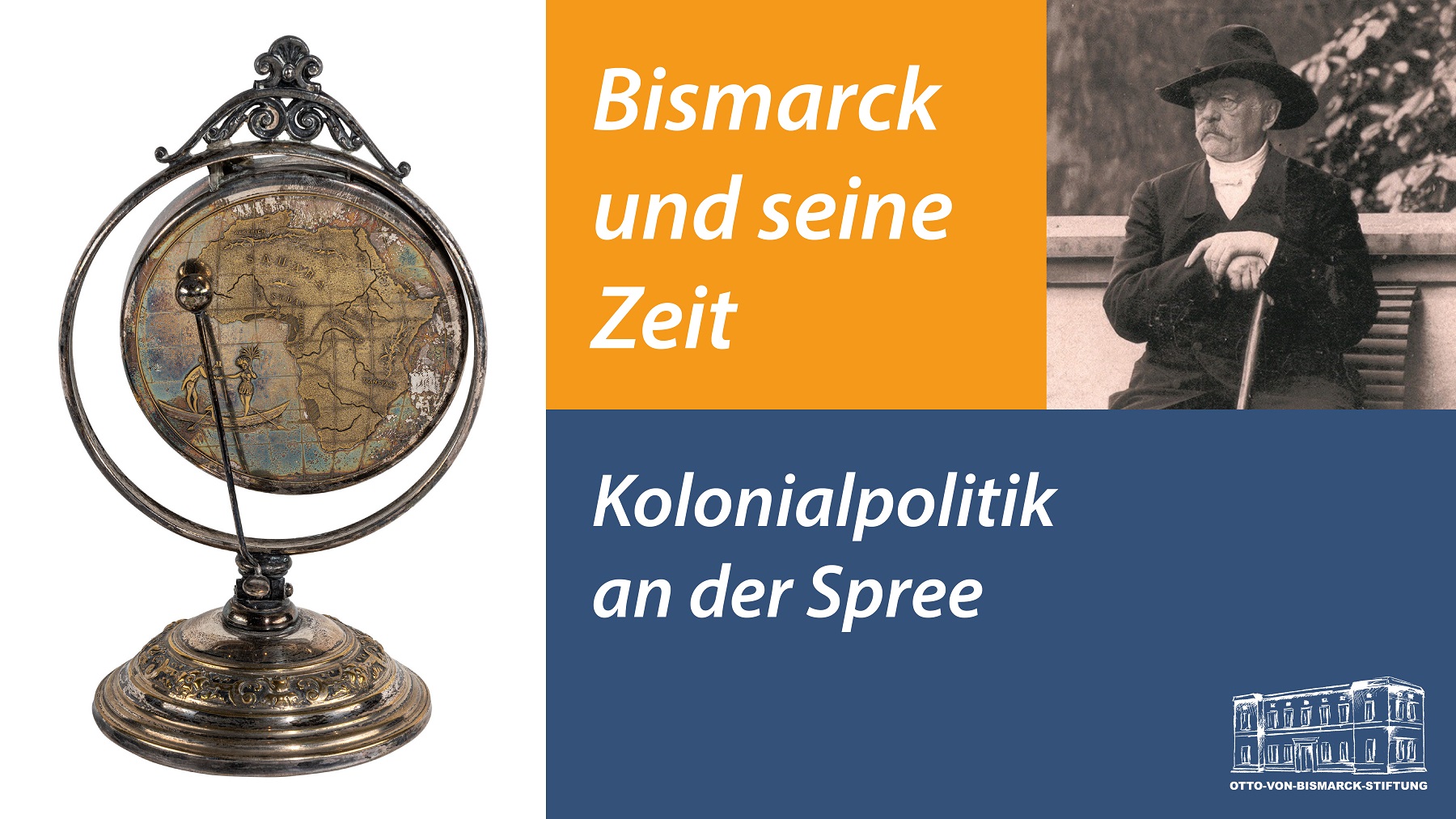
A cash book from the Hamburg colonial company Jantzen & Thormählen and a table gong draw attention to the beginnings of German colonial policy under Otto von Bismarck in our permanent exhibition in the historic Friedrichsruh train station. We show them in this one Video together with some historical photographs from our archive, which the colonial company had taken on the West African coast.