"Chancellor without office"
1890 – 1898
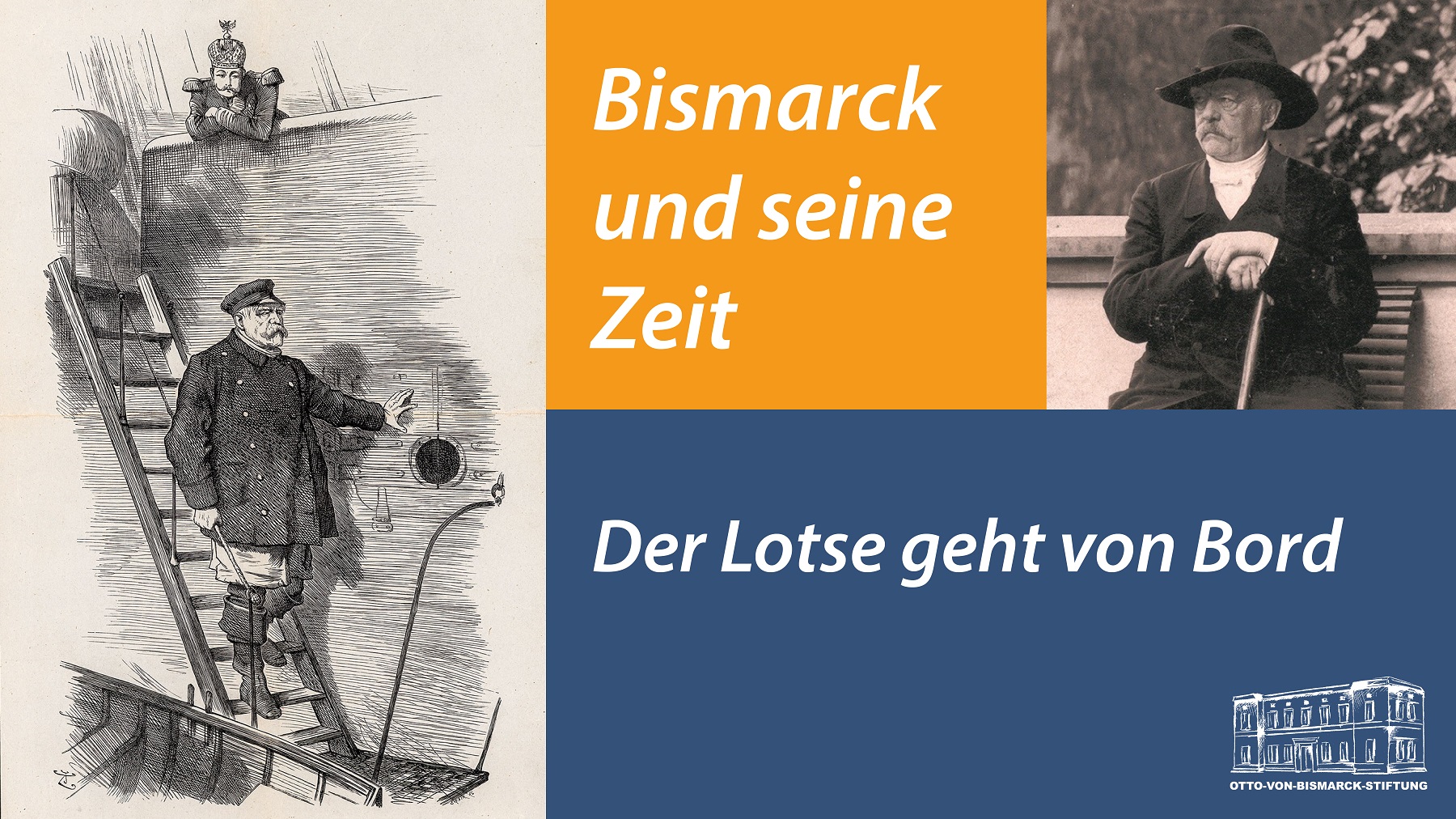
 Dropping the pilot, cartoon by John Tenniel, published in: Punch, March 29, 1890 (reproduction © Otto-von-Bismarck-Stiftung)
Relief and dismay
When Bismarck was dismissed from all offices by Emperor William II and left Berlin from Lehrter Bahnhof on March 29th, 1890, a large crowd bid him farewell with frenetic cheers. From the point of view of his supporters, the Imperial Chancellor's resignation possessed almost global significance. "Not since Themistocles has the world seen such a tragic fate," wrote Heinrich von Treitschke. Foreign countries also reacted with dismay and concern.
Equipped with an annual pension of 18.000 marks, Bismarck resentfully retreated to Friedrichsruh. Soon he had to realise that, in addition to the feeling of shock, relief was also spreading among the population. At last the path of the German Empire seemed clear for a course that would be more in keeping with the dynamics of the times. "It is fortunate that we are rid of him. Many questions will now be dealt with better, more honestly, more clearly than before," Theodor Fontane. And the young Harry Graf Kessler noted after a visit by the former Imperial Chancellor: "The longer one listened, the more one was forced to realise that [... he offered] us young Germans a political life of permanent retirement, just the defence and enjoyment of what had already been acquired; our creative urges went empty-handed."
Cultic veneration
The young emperor's "creative urges" soon went too far for quite a few Germans. And the more dissatisfaction was caused by policies of William II, which were declared to be a "new course", the more the Germans projected their unfulfilled desires onto the old man in the Sachsenwald. On his 80th birthday in 1895, the jubilarian was showered with some 450.000 congratulatory letters.
Bismarck not only enjoyed the cult-like veneration, he even fuelled it: although he resigned from the Reichstag mandate that the National Liberals had offered him, the "chancellor without office" (Manfred Hank) gave free rein to his criticism of the domestic and foreign policies of his successor Leo von Caprivi. Bismarck was concerned not only about the end of the Anti-Socialist Laws, but also about the non-renewal of the German-Russian Reinsurance Treaty and the intensification of colonial policy. The Reich had to preserve what the founders had "laboriously brought home under the threatening [...] gun barrels of the rest of Europe", was his credo.
The former Imperial Chancellor sniped at the government's policies in eloquent speeches and numerous press articles. In this way, he not only wanted to stop what he perceived as undesirable developments. He was also concerned with securing his posthumous fame.
 The pensioner Bismarck misses his son Herbert. For him, the spear with the inscription "Against Caprivi" seems clearly too big. The caricature appeared in the Humoristische Blätter. (Public domain)
"True leader of the opposition"
The feud between Friedrichsruh and Berlin reached its climax in the summer of 1892. On the occasion of the wedding of Bismarck's eldest son Herbert in Vienna, Emperor William II asked Emperor Franz Joseph to deny the former Imperial Chancellor an audience. In an interview, Bismarck judged this interference to be a definitive break. On his return journey to Friedrichsruh, he bluntly criticised government policy in public speeches.
The stream of admirers who made pilgrimages to the Sachsenwald or cheered Bismarck at his health resorts in the following years swelled to previously unknown proportions. From the point of view of foreign observers, he rose to become the "true leader of the opposition" (Camille Barrere).
 In 1894 and 1897 Kaiser Wilhelm II visited the old Reich Chancellor in Friedrichsruh to avoid a political break. The photograph by M. Ziesler, Berlin, shows an earlier visit on 29/30. October 1888 (Collection of Otto-von-Bismarck-Stiftung)
The political leadership in Berlin had no interest in breaking with the former head of government. But following his advice was out of the question. A reconciliation meeting arranged by the court in Berlin in early 1894 and a visit by William II to Friedrichsruh in 1895 did nothing to change this. After the former Imperial Chancellor had the top-secret circumstances of the non-renewal of the Reinsurance Treaty published a year later, the Emperor even threatened imprisonment. In his infamous "Pygmy Speech", William II demoted Bismarck to a mere "henchman" of his grandfather William I
"My trumpet is full of holes"
Due to his increasing physical frailty, Bismarck's interventions became fewer and fewer. After the death of his wife Johanna in 1894, he had hoped to be allowed to follow her soon, as old age held only bitterness and loneliness in store for him. "My trumpet no longer makes a sound, it is full of holes," Bismarck complained to his family doctor. He spent the last years of his life, largely isolated from the public by his family, at his retirement home outside Hamburg. He died on July 30th, 1898.
Video: The pilot disembarks
The famous caricature "The pilot disembarks" and a painting by the painter Franz von Lenbach - to be seen in our permanent exhibition in the historic train station in Friedrichsruh - tell of the end of a chancellorship that shaped German history.