"Variety is the soul of life"
Anecdotes and Quotations
Bismarck often spoke and wrote very vividly, some of his political statements have become dictums. In addition, numerous anecdotes from his life have been handed down from family members, good acquaintances and political interlocutors, which sometimes show little-known aspects of his personality.
Anecdotes
-

To his mother's chagrin, as the writer Paul Liman reports, little Otto von Bismarckloved to put anything that seemed edible into his mouth.
...
-

The poet Hans Bethge reports on an attack by the youthful Otto von Bismarck on a statue of Hercules in the park of his parents' Schönhausen estate.
-

The publicist Friedrich Schmidt-Hennigker reports on the healing effect of a sausage on Otto von Bismarck, who was suffering from malaria as a student.
-

On a trip to Bismarck's Varzin estate in Pomerania in XNUMX, journalist Moritz Busch hears a story about Bismarck's Sturm und Drang period in the 1877s at Kniephof estate.
-
Anna Ebers, a local historian, tells us why Bismarck abruptly ended his traineeship with the provincial government in Potsdam in 1844.
-

In his "Thoughts and Memories", Bismarck reports on his struggle against the 1848 revolution in Schönhausen.
-
Bismarck's assistant in Frankfurt, Justus von Gruner, reports on a walk together on the Main promenade in May 1851.
-
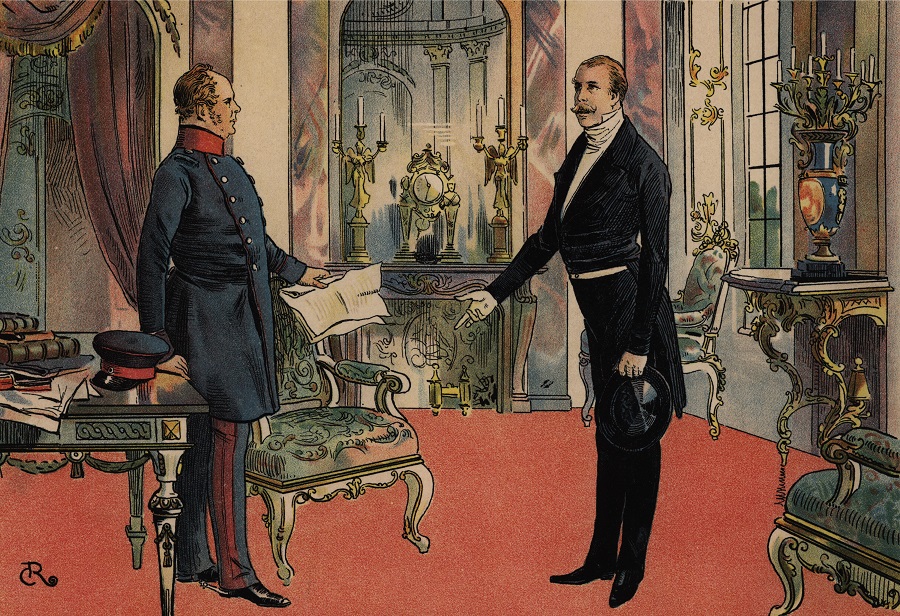
In his memoirs, Bismarck describes how King Frederick William IV. appointed him a legation councillor at the Bundestag in Frankfurt am Main in 1851 and held out the prospect of promotion to envoy.
...
-

In a conversation with the journalist Moritz Busch in 1877, Bismarck recalls a conflict with the Austrian diplomat Karl Ferdinand von Buol-Schauenstein over cigar smoking at the Bundestag in Frankfurt in the early 1850s.
-
During a visit to Friedrichsruh by the writer and physician Wilhelm Gittermann in 1892, Bismarck recounts an anecdote from his time at the German Bundestag in Frankfurt in the 1850s.
-
In October 1855, Bismarck tells the diplomat Robert von Keudellhow he helped a man wanted by the police to escape.
-
In a review of his life, Justus von Gruner tells of an encounter with Bismarck on the occasion of the meeting of Tsar Alexander II, Emperor Franz Josef and the Prussian Prince Regent Wilhelm in October 1860.
-

Publicist Tim Klein tells an anecdote about Bismarck after his appointment as Prussian Minister-President in 1862.
-

In her collection of Bismarcks words, Christa Gräfin v. Eickstedt-Peterswaldt describes Bismarck's negotiations with the Austrian diplomat Gustav von Blome on the division of the administration of the duchies of Schleswig, Holstein and Lauenburg in June 1865.
-
During a visit by the publicist Paul Liman, Bismarck recounts an encounter with a wounded soldier after the Battle of Königgrätz in July 1866.
-
In October 1884, Bismarck tells his associate Arthur von Brauer about a hunt at the home of a Mecklenburg landowner in 1866.
-
In his "Book of Count Bismarck", the writer George Ezekiel describes a table conversation Bismarck had about the Prussian-French conflict over Luxembourg in the spring of 1867.
-

In a dinner conversation with his staff at Versailles headquarters in August 1870, Bismarck rants about beer consumption.
-

At a dinner conversation with Prince Wilhelm Malte von Putbus in Versailles in November 1870, Bismarck rages about the treatment of French civilians during the war.
-

In a dinner conversation with his press aide Moritz Busch and Privy Councillor Heinrich Abeken in Versailles, Bismarck describes a conflict with King William of Prussia before the Emperor's Proclamation on 18 January 1871.
-

In his memoirs, Bismarck describes his thoughts on his elevation to the Princely state in March 1871.
-

In the summer of 1871, Bismarck talks to his head forester Ernst Westphal about his concerns for the park in Varzin during the war against France.
-
On a drive through the Sachsenwald with the diplomat Robert von Keudell in the autumn of 1872, Bismarck recalls key milestones in his political career to date.
-
In a conversation with the civil governor of Livonia, Burchard von Oettingen, in October 1872, Bismarck recounts Emperor William I ‘s love of Varzin sausages.
-
During a dinner conversation with the wife of a foreign diplomat, Bismarck humorously points out that said diplomat is not necessarily skilled at his job, playing on the double meaning of “gesandt” meaning “sent” and “geschickt” as either “sent” or “skilful”.
-
Bismarck's associate Arthur von Brauer recounts the Imperial Chancellor's refusal in 1874 to seek judicial retribution for an insult.
-

The head of the Imperial Chancellery Christoph von Tiedemann recalls Bismarck's culinary excesses during his first visit to Friedrichsruh in January 1875.
-

During a conversation with district administrator Christoph von Tiedemann and the historian Heinrich von Sybel in January 1875, Bismarck philosophized about love and hate as a spur to life.
-
In a conversation with the Prussian Minister of Agriculture Robert Lucius von Ballhausen in May 1875, Bismarck comments on the Germans' attitude to politics.
-
In conversation with Prussia's Minister of Agriculture Robert Lucius von Ballhausen in February 1876, Bismarck criticises the introduction of a new spelling system.
-

In a conversation with the head of the Imperial Chancellery, Christoph Tiedemann, Bismarck laments the death of his Great Dane Sultan in October 1877.
-
On a ride with the head of the Imperial Chancellery, Christoph Tiedemann, in February 1878, Bismarck searches for a concise term to characterise Germany's position vis-à-vis the entanglements in the Orient.
-

During a visit by the ministerial official Julius von Eckardt in March 1884, Bismarck recounts an encounter with an old woman in the Sachsenwald (Saxon Forest)
-
After a meeting with Bismarck, the Baroness Hildegard of Spitzemberg notes a "little story" about Bismarck's superstition in May 1887.
-

In November 1887, the English painter Sir William Richmond visits Bismarck in Friedrichsruh and reports on it.
-

During a visit to Friedrichsruh by the Consul General Gustav Michahelles with a legation from the Sultan of Zanzibar, Bismarck demonstrates his sprightliness on horseback in October 1889.
-

At the end of the 1880s, Bismarck criticised to his advisor Arthur von Brauer the intention of some admirers to build a Bismarck Museum in Berlin.
-
In the late 1880s, Bismarck praised the importance of agriculture to his head forester Ernst Westphal from Varzin.
-
In May 1892, Bismarck tells the English writer Sidney Whitman about a dinner with Emperor William II in the late 1880s.
-

During a visit to the physician Dr. Wilhelm Gittermann in Friedrichsruh in February 1893, Bismarck ponders the dualism of existence on earth.
-

During a visit to Friedrichsruh by the writer Maximilian Harden in January 1894, Bismarck tells him that he wants to find his final resting place in the Sachsenwald.
-
At a dinner with the publicist Friedrich Schmidt-Hennigker in February 1895, Bismarck muses on happiness.
-

On a visit to Varzin, the English writer Sidney Whitman asks Bismarck why he has given up hunting, once so passionately pursued.
-

Bismarck's physician Ernst Schweninger reports the following episode from the last days of his life.
...
Quotes
-
The Prussian civil servant is like the individual in the orchestra; he may play the first violin or the triangle: without overview and influence on the whole, he must play his fragment as it is set for him [...] But I want to make music as I know it to be good, or none at all.
-
With bad laws and good officials (judges) we can still govern, but with bad officials the best laws are of no use.
-
It is easy for a statesman [...] to sound the war trumpet [...], but woe to the statesman who at this time does not look around for a reason for war that is still valid after the war.
-
The only sound basis of a large state, and in this it differs essentially from a small state, is state egoism and not romanticism.
-
Variety is the soul of life
-
We are not in this world to be happy and to enjoy, but to do our duty.
-
I don't know how I endured it before; if I should live now as I did then, without God, without you, without children – I really don't know why I shouldn't discard that life like a dirty shirt.
-
The main means by which the evil one attacks me lies not in external splendour, but in a brutal sensuality that leads me so close to the greatest sins that I sometimes despair of finding access to God's grace, and in any case have the certainty that the seed of the divine being has not found the good soil in my heart, which has been running wild since my youth.
-
I have no fondness for today's official Bavaria, beer excepted.
-
Does anyone deserve the foreign medals they wear? They are not just rewards, but bribes.
-
Life is like a skilful tooth-pulling; one thinks the real thing is yet to come, until one sees with astonishment that it is already over.
-
We must work with realities and not with fictions.
-
We will become the anvil if we do nothing to become the hammer.
-
Ah, happy is the youth who can always shout hurrah.
-
Follow my advice and my example, drink a bottle of champagne and eat a few dozen oysters with it, and I am convinced that the world situation will immediately appear to you in a far rosier light.
-
It is not by speeches and majority decisions that the great questions of the day are decided - that was the great mistake of 1848 and 1849 – but by iron and blood.
-
In my politics, I may be attacked, but I only laugh about it. But when it comes to hunting, that's where the fun stops, that's where it gets serious.
-
Politics is not an exact science; with the position one has before oneself, the way in which the positions are used also changes.
-
There is so much having to do in my life that I rarely get to want to do.
-
Let's put Germany, so to speak, in the saddle! It will be able to ride.
-
He who does not honour the prestige of compromise is everywhere not ripe for a constitutional system; for constitutional life consists of a series of compromises.
-
That German unity would be promoted by violent events I too think likely. But the profession of bringing about a violent catastrophe is quite another question.
-
The ability to wait while circumstances develop is a prerequisite of practical politics.
-
We cannot ignore the history of the past, nor can we, gentlemen, make the future; [...] we cannot make history, but only wait for it to take place.
-
Outbursts of emotion [do] not [belong] in politics.
-
If I did not believe in a divine order [...], I would give up the diplomatic profession right away or not have taken on the business at all! Orders and titles don't appeal to me. [...] Take away my faith and you take away my fatherland.
-
Even if many people in Germany now became Catholic again - I won't - that wouldn't mean much if they were only devout Christians. It's not the denomination that counts, it's the faith. You have to think more tolerantly.
-
Simplicity without conceit is bearable. But to be simple-minded, impractical and conceited is intolerable.
-
This imperial birth was a difficult one, and kings have their whimsical desires at such times, like women before they give away to the world what they cannot keep. As an accoucheur I had several times the urgent need to be a bomb and to burst that the whole building would have gone to ruins.
-
Laws are like medicines, they are usually only cures of one disease by a lesser or temporary disease.
-
My sleep is no rest; [...] the other day I saw [in a dream] the map of Germany before me, in it one rotten spot after another appeared and flaked off.
-
According to God's will, what is necessary for Germany has been achieved. But new dangers and damages are always emerging, damages that we must try to heal, even if we cannot know whether the healing will succeed. I often long for rest; but for me there can be no rest.
-
Hatred, however, is as great a spur to life as love. My life is sustained and embellished by two things: my wife and - Windthorst. One is there for love, the other for hate.
-
Qui parle Europe a tort. notion géographique [anyone who speaks of Europe is wrong. geographic concept]
-
I have always found the word 'Europe' in the mouths of those politicians who demanded of other powers what they dared not demand in their own name.
-
If I were fit for work, I could complete and elaborate more finely the picture which I have in mind: not that of any acquisition of territories, but that of an overall political situation in which all the powers except France would need us and would be kept from coalitions against us by their relations with each other as far as possible.
-
I do not think of the mediation of peace in such a way that we now play the arbitrator in the case of divergent views [...], but I think of it more modestly, [...] more that of an honest broker who really wants to bring about the business.
-
The German has in and of himself a strong tendency to discontent.
-
For me there has always been only one compass, one pole star, by which I steer: Salus publica!
-
There are times when you have to govern liberally and times when you have to govern dictatorially, everything changes, there is no perpetuity here.
-
Now 50 per cent of the male population sit in the pub in the evening, drink beer, smoke cigars or even pipes, ramble about the government and then go home proudly as if they had done a hard day's work.
-
It is a mistake not to be allowed to make a U-turn in politics. A U-turn is the only means of getting out of a dead end.
-
It is part of the German need to speak badly of the government over a beer.
-
In other countries the parties support the government in many essential things for the benefit of the country; with us each party stuffs its own mattress and wants to stuff the government into it; now what is our country to do with seven or eight parties?
-
This people cannot ride. Those who have something do not work, only the hungry are industrious, and they will eat us.
-
Politics is not a science, as many of the professors imagine; it is simply an art.
-
Every war, even the victorious one, is always [...] a great misfortune for the country that wages it.
-
If someone utters slander in a letter written anonymously, it is generally considered a dishonourable occupation; but if someone does so in printed papers, equally anonymously, it is 'freedom of the press'.
-
There are a lot of people who have only one thought all their lives, and they never come into conflict with it. (Great merriment) I am not one of them; I learn from life, I learn as long as I live, I learn even today. It is possible that in a year or a few, if I still live to see them, I shall regard what I hold true today as a viewpoint that has been overcome, and I shall wonder: How could I have been of this opinion before?
-
Politics is not a science to be learned, it is an art, and he who cannot do it had better stay away from it.
-
It is easier to criticize than to govern.
-
In foreign policy [it is] not sentiments but interests and reciprocity that are to be taken as a guide.
-
I love the big trees, they are the ancestors.
-
I am all nerves, to such an extent that self-control has been, and still is, the only task of my life. [...] I am very hot-blooded and always have to fight against my temper dragging me away in the house.
-
We Germans fear God, but nothing else in the world (Lively bravo!); and it is the fear of God that makes us love and cultivate peace.
-
Your map of Africa is very nice, but my map of Africa is in Europe. Here lies Russia, and here [...] lies France, and we are in the middle; that is my map of Africa.
-
If you remain brave, you have nothing to fear.
-
In liberalism, after all, dictatorship is natural; those who do not go along are thrown overboard.
-
Quieta non movere, that is, what lies still, do not disturb, and that is genuinely conservative.
-
Politics is like a big trout eating up the little trout [...] and so politics has swallowed up every other hobbyhorse I have ever had.
-
We need the Reichstag, we need its authority, we have to support and promote it.
-
You cannot make history at all, but you can always learn from it how to direct the political life of a great people according to its development and its historical destiny.
-
Nowadays we can no longer live purely dynastic politics, but we must practise national politics if we want to exist.
-
It may well be that God has in store for Germany a second period of disintegration and then a new period of glory, on a new basis of the Republic, but that no longer affects us.
-
His death always tears a hole in my life and my surroundings, even though I was more conscious of my brother's existence than physically aware of it.
-
We Low Germans don't talk much, we are stronger in deeds than in words.
-
Dear child, death must come once and for all, and I will at least see to it in time that no mischief is done with my corpse. I don't want to be, as the Berliners say, a beautiful corpse; a funeral comedy staged with the familiar sincerity that secretly goes 'Oof!', something between a bird's meadow and a procession, would be about the only thing that could still frighten me.
-
You see me touched and moved. Yes, this is a new time – a whole new world.
-
In politics there is no happiness for those who pursue it, as I have had to pursue it. The statesman is like a stock exchange gambler. When he has won a million today, and he thinks he can rejoice over it, then already comes the worry as to how he can invest the millions he has won for further speculation. [...] The statesman deals with other people's assets, and the more sense of honour one has in one's body, the more serious this becomes.
-
Man cannot create or direct the stream of time; he can only sail it and steer.
-
I always regret that our better half of the human race is not allowed more influence on political conditions.
-
It is often less harmful to do something wrong than to do nothing.
-
One cannot create anything oneself; one can only wait until one hears the step of God echoing through events; then leap forward and grasp the tip of his cloak – that is all.