Stay at the favourite health resort
Bismarck in (Bad) Kissingen
Cures in a "blessed land"
Since his appointment as Prussian minister-president, Bismarck took the waters almost every year. He hoped to recover from the stresses and strains of government business and to alleviate his health problems.
His (K)holidays first took him to Karlsbad in Bohemia or to Bad Gastein, but after the founding of the German Empire he was mostly drawn to Kissingen. It is not entirely clear why Bismarck chose the location in Lower Franconia. In addition to the good reputation of the bath and the healing power of the water, a third aspect may have convinced the Chancellor: King Louis II of Bavaria provided him with horses. They allowed him to enjoy the solitude in the forests of the "blessed land".
 Otto von Bismarck and his doctor Ernst Schweninger in the courtyard of the Upper Saline, undated photograph by Jacques Pilartz (photo collection of the Bad Kissingen City Archive)
 Otto von Bismarck's apartment was in the representative residential building of the “Obere Saline! (Upper Saltworks). The Kissinger Bismarck Museum is located there today. (© Otto von Bismarck Foundation)
Big politics in the “Upper Saltworks"
The reason for the only relative success of the cures lay in Bismarck's intention never to let political leadership out of his hands. As in a government headquarters, the Imperial Chancellor received domestic and foreign statesmen in the "Obere Saline" [Upper Saltworks]. Here he dictated directives to his closest staff, which were then sent to Berlin by courier or telegraph. It was here that the famous "Kissingen Dictation" of June 15th,1877 was written. Not even his involuntary resignation in 1890 prevented Bismarck from conducting politics from the Kissingen terrain. With sensational speeches, he pursued his very own form of extra-parliamentary opposition to the government and the emperor.
 Otto von Bismarck in his study in the "Obere Saline" (Upper Saltworks), drawing by Josef Arpad Koppay. (© Bismarck Museum Bad Kissingen, photographer: Rudi Merk)
Kissingen's veneration of Bismarck
Bismarck could be sure of the approval of the people of Kissingen. Already during his reign, the magistrate had erected a monument to the prominent guest and conferred honorary citizenship on him. After his resignation, whole crowds from near and far flocked to patriotic rallies in front of his house. To welcome the crowds and the illustrious guest, the mayor sometimes called on the homeowners of Bad Kissingen to have their buildings appropriately “illuminated and decorated with flags”. The town also participated in the most publicly visible form of the Bismarck cult, the construction of Bismarck towers. However, the tower was not completed until 1986, 93 years after Bismarck's last stay on the Saale.
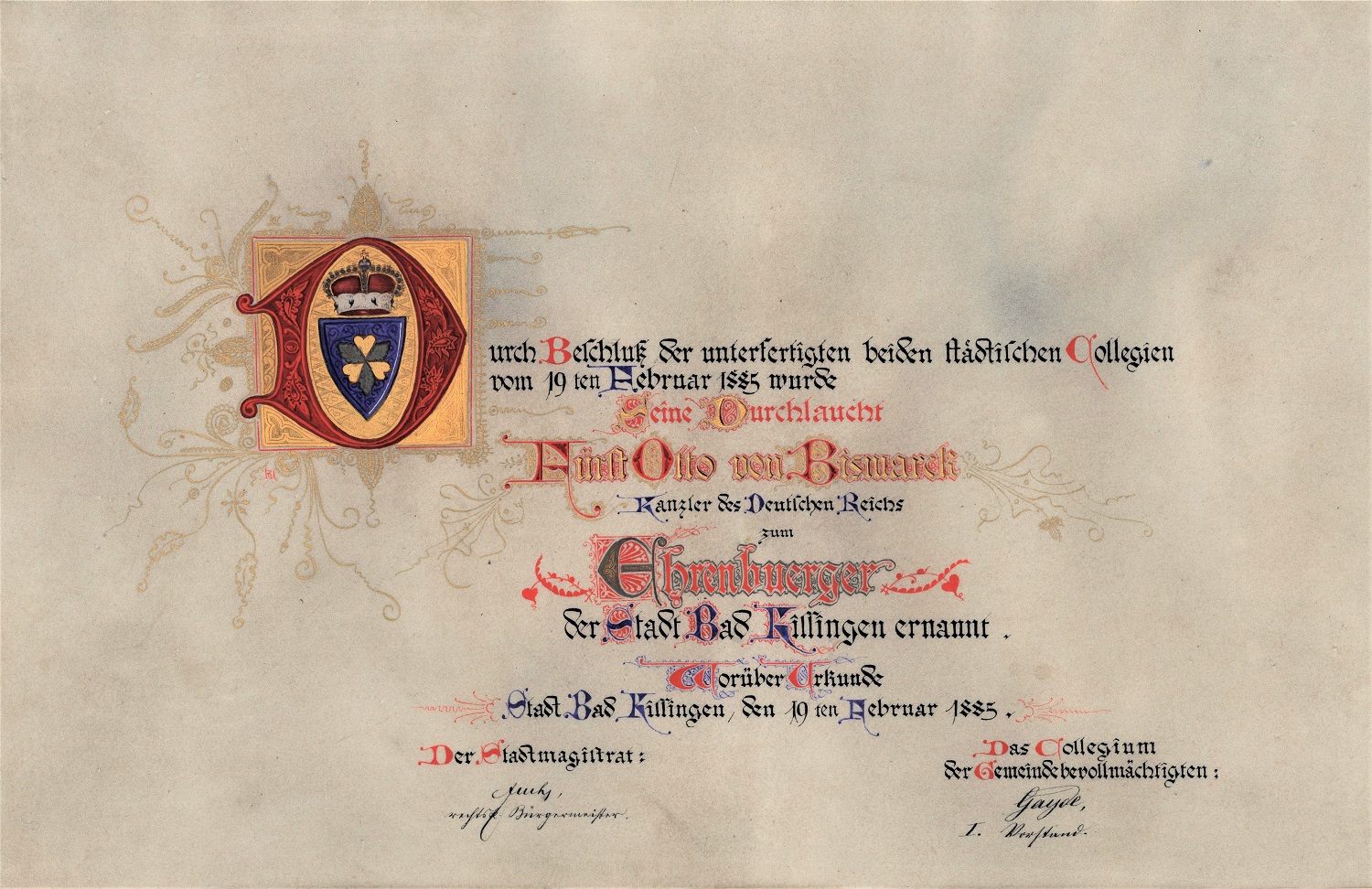 Bad Kissingen awarded Otto von Bismarck a honorary citizenship on 19 February 1885. (© Otto von Bismarck Foundation)